Friday, March 09, 2007


Tuesday, March 06, 2007
How Many Years Does This Teacher Get?
Well, middle school was never like this when I was a student! (h/t to the Education Wonks via Pharyngula)
My mind immediately flashed to the Julie Amero case when I read this story of 10 Indiana sixth-graders watching as two of their classmates performed a live sex show ("completed the act of intercourse," in the quaint language of a "disturbed resident" who reported the case to a local TV station) while their teacher was in the room!
If Amero's students were so terrifyingly endangered by a mere glimpse of digital porn that their unfortunate teacher is guilty of multiple felony counts, surely this teacher is ticketed for lethal injection, right? Well, not so much: Apparently "Warren Township School Police were not aware of the incident and say no report was made even though the children were recommended for expulsion." Hmmm... expel the preteens, but as for the teacher... no harm, no foul, I suppose. No need to even bother the cops with a report. Move along, folks; nothing to see here.
Mind you, I'm not after the teacher's scalp: Apparently the students conspired to hide this illicit activity, and the teacher took action as soon as he (or she; the news story studiously avoids "outing" the teacher's identity in any way) discovered something inappropriate was going on. But what kind of upside-down, inside-out world is it when Amero sits branded a sex offender and waiting to learn how much time she'll spend in prison while this teacher is happily making up next week's lesson plans?
Monday, February 19, 2007
Sign, Sign, Everywhere a Sign...
OK, maybe this isn't "blockin' out the scenery," but it sure is "breakin' my mind"! [1] I was just sitting here peacefully listening to Rachel Maddow's Air America Radio show from last Friday (I listen by podcast, so I'm always one weekday behind). In the course of discussing who did and didn't vote against the recent anti-Iraq War resolution in the House, Rachel mentioned that the Washington Post website, which she uses to check congressional vote roll calls, offers readers the ability to display votes sorted by astrological sign! Huh?!? Well, I had to see it for myself, and sure 'nuff:

Alright, I don't know whether to be more discouraged by the idea that people who care enough about politics to look up vote totals actually want to know about legislators' signs, or by the fact that WaPo would cater to their bizarre superstition. Either way, I think I have to make this a short post, so I can go pour cool water over my steaming brain....
[1] If this reference is too ancient/obscure for you, look here.
UPDATE: I e-mailed PZ Myers, Rationalist-in-Chief at Pharyngula, about this and he very flatteringly linked to this entry. A couple of commenters noted that the intention was just to have some lighthearted fun and attract readers to the (admittedly very cool) Votes Database. Well, that makes me feel better... but only a little bit better. I used to be firmly in the it's-harmless-fun-as-long-as-you-don't-believe-it camp regarding astrology and such, but I'm increasingly concerned that even such benign bemusement gives aid and comfort to the all-too-numerous inhabitants of the demon-haunted world we live in.
Besides, are astrology believers really the voters we want to be enabling?
Wednesday, February 14, 2007
Al Franken For Senate!
Former (sadly, as of today) Air America radio host Al Franken has announced his run for the Minnesota U.S. Senate seat now held by Norm Coleman (and before that, by Franken's political hero, Paul Wellstone). I don't live in Minnesota, of course, but Franken has been a tireless voice for progressive issues and in opposition to the current right-wing regime, so his run is of interest to us all. Besides, his Midwest Values PAC supported Democratic candidates all around the country in 2006, including our very own Joe Courtney and Diane Farrell... so I, for one, plan to return the favor. Here's Al's announcement video:
Here is Franken's campaign website, where you can contact the campaign, read Al's bio, or contribute.
I have contacted the campaign to find out what out-of-staters can do to help; I'll let y'all know what I find out.
When I posted an earlier version of the above as a diary at the Connecticut progressive blog My Left Nutmeg, a commenter quickly replied that Al Franken "is pro-war," and that progressives should hope for a better Democratic candidate, linking to two articles (here and here) by one John Walsh, posting at CounterPunch, a self-described "bi-weekly muckraking newsletter."
I admit I'm not familiar with John Walsh, but a quick scan of the articles to reveals an extreme POV: Anyone who thinks Sam Seder, Janeane Garafalo, Randi Rhodes, and Rachel Maddow are insufficiently antiwar, or that the network that put them all on the air is "little more than a mouthpiece for the DNC" is just not going to be satisfied with any feasible candidate!
I've listened to virtually every Franken show for more than 2 years, and I can say without hesitation that Al is the polar opposite of pro-war! I defy anyone to listen to the show (at least some of the podcasts are still archived, though you may need to join Air America Premium to get them) with anything even vaguely approaching an open mind and conclude that Franken can be fairly called "pro-war."
John Murtha, whom Walsh claims Franken doesn't support, is actually something of a hero to Franken... so much so that he almost had an on-air falling out with regular guest Melanie Sloan when she called Murtha on his ethics issues. I've never heard him say anything bad about Murtha. Al supports the "soft partition"/redeployment-to-Kurdistan plan advanced by Peter Galbraith, et al., which may not be identical to what Murtha proposes, but it's similar in spirit... and certainly not a stay-the-course position. One thing about Franken is that he's willing to listen to other people's ideas (are we to believe this is a bad trait in a legislator??)... but I've never heard him agree with, or express support for, anything that could be called pro-war or pro-escalation.
It's also true, as Walsh notes, that Franken has covered corruption, fraud, and incompetence in Iraq contracting: Tom Ricks' Fiasco, which Franken calls "indispensible" is something of a bible for the show. Does this make him pro-war? Because the war itself is immoral and evil, we're supposed to give crooks and war profiteers a free pass? The mind boggles!
Franken has also covered veterans' issues and troop equipment issues (e.g., the founder of Operation Helmet has been a frequent guest), and every year he goes on USO tour in the Iraq and Afghanistan theatres. Do these things make him "pro-war"? Many, if not most, liberals and progressives have taken the position that they oppose the war but support the troops; few... perhaps none... have honored both ends of that proposition as completely as Al Franken.
And the Al Franken show has also covered issues not related (or at least not directly related) to the war (e.g., the DeLay, Cunningham, et al., scandals). Does this make him an unacceptable candidate for Senate in 2008? think about it for a moment: If elected, Franken won't finish his first term until 2014. I pray to all that's holy that the Iraq war won't still be the primary issue of the day by then; if it is, we're doomed in any case. Among all the other tragedies of this war, one is that it's distracting us from all the other ways in which the right-wing regime has hosed up our government. While the war is clearly the most critical moral challenge of our time, it is not the only challenge facing our government; we elect representatives who focus on the war to the exclusion of all else at our peril.
You may be able to think of reasons (though personally I cannot) not to support Al Franken... but the notion that he's pro-war is not one of them.
IMHO, of course... ;)
Thursday, February 08, 2007
Click Your Congresscritter
OK, I've already posted this on blogs that people actually read, but I thought I'd put it up here, too, just in case:
In the Fall of 2001, my daughter was diagnosed with a cancerous brain tumor. Through the miracle of modern medicine -- including 14 hours of surgery and more than a year of chemo and radiotherapy -- the wonderful doctors and nurses at Connecticut Children's Medical Center saved her life, and today she's happy and healthy.
In the Fall of 2001, my daughter was diagnosed with a cancerous brain tumor. Through the miracle of modern medicine -- including 14 hours of surgery and more than a year of chemo and radiotherapy -- the wonderful doctors and nurses at Connecticut Children's Medical Center saved her life, and today she's happy and healthy.
I can't say exactly how directly federally funded research contributed to her recovery, but I'm sure it was instrumental. One organization that was a tireless advocate for children with cancer was the National Childhood Cancer Foundation, now called CureSearch.
CureSearch has put out an alert regarding threats to federal cancer research funding. If you feel so moved, I urge you to use their online tool to send letters to our members of Congress, and then follow up with a personal e-mail to your representative.
We're all concerned with the war, of course, but even in the midst of crisis, life -- and the hard work of saving lives -- goes on.
Tuesday, February 06, 2007
Fly Me to the Moon
A quick post tonight. I have recently purchased an "electronic eyepiece" for astrophotography (astrovideography, really). It's essentially a webcam packaged to be used with a telescope in place of the normal visual eyepiece. I'm not very good with it yet (and I need to build a new mount for my scope), but I did manage to get this shot of the moon last Monday:

...and this one just tonight:


...and this one just tonight:

Sunday, February 04, 2007
My $100 Tennis Racquet
Well, obviously I've been neglecting this blog for more than half a year, during which time I've worked on the successful Joe Courtney campaign for the Connecticut 2nd District seat in Congress, going on a Thanksgiving weekend tour of New England college campuses with my daughter, having a (quite unexpected) case of whooping cough, taking my daughter and her friend to a Harry Potter themed Yule Ball concert, visiting family in Florida for Christmas. In all that time, somehow, I fell out of the habit of updating this chronicle. Oh, during the election season I contributed to other blogs (mostly My Left Nutmeg), but nothing here.
I apologize for the silence.
When I was (much) younger, I played tennis... but I found that, owing to the busy life of a young college student, sometimes weeks or even months would go by without me finding time to hit the courts. This frustrated me because I really wanted to play regularly. One summer I went out and spent $100 dollars -- a lot of money in those days, for me at least -- on a top-quality racquet. It wasn't so much that I needed a fancy racquet -- I was never that good anyway -- but that I wanted to make some act -- in this case a nontrivial monetary investment -- that would force me to take the activity more seriously. Now I've done something similar: I've started including a link to this page in my profile at other online sites, including my Facebook page, my My Left Nutmeg profile, and, most recently, on the newly refurbished 2nd Congressional District blog.
I hesitate to promise any set frequency of posts. I'm going to try to post something short fairly often, even when I don't have a full-length rant in me (or don't have time to do it justice). In any case, I won't abandon this blog again, so please keep checking back!
(BTW, the Unit of the Day will no longer be a feature of every post... but I'll still post one whenever I see a unit that strikes me as engagingly peculiar.)
Tuesday, August 01, 2006
Lamont v. The Enabler
Well, I didn't exactly get around to discussing the Connecticut Democratic primary for U.S. Senate "tomorrow" as I promised, but the serendipitous advantage of that I've now seen Ned Lamont's appearance on The Colbert Report (no video up yet as I write this, but My Left Nutmeg has a comments thread here).
Despite lots of talk in the local press (e.g., this) that going on Colbert's show was a risky move, I thought Lamont did very well. As several Left Nutmeggers pointed out, he wasn't terribly funny, but trying to outfunny Colbert is usually a losing strategy anyway, I gather. He was composed and straightforward, and most important to me, he used the word I've been waiting to hear: He said Joe Lieberman enables the president.
Look, at some level I have no business blogging on this. I'm not the world's greatest expert on the campaign... heck, I'm not even my household's greatest expert on it! But I am an expert on why I support Lamont and oppose Lieberman, and I get tired of the way the campaign's being characterized. Even when superficially complimentary to Lamont and critical of Lieberman, many commentaries (e.g., here) persist in characterizing the race as a single-issue contest, or as being all about "netroots" versus old-line pols, or as a struggle between ideology and electability, or (e.g., here) as an "elitist insurgency." Why is it so hard for the punditocracy to believe that, at least for some of us, this is not some "inside baseball" political game, but in fact a simple matter of principle? For me, it's not just about the war, as important an issue as that is. It's not about the 90 percent of the time Lieberman has voted with the Democratic leadership, nor the several very important times he has not: Iraq, Alito cloture, the energy bill, etc. Instead, it's about the tone and tenor of Lieberman's relationship with the Bush administration. It's about saving the republic.
Lieberman brags about having the courage of his convictions, and about his commitment to bipartisanship... and in other times, those might be good things to brag about, indeed. But this is a unique moment in history: For the first time in my lifetime -- a lifetime that spans Watergate and most of the Vietnam War, BTW -- I think we're on not only the wrong track, but so disastrously wrong a track that I fear for the future of our national enterprise. The war, our generally belligerent foreign policy, the economy, the assaults on civil liberties at home and human rights abroad, the contempt for science and learning, the dismantling of the infrastructure of public culture, and the attempts to render these things permanent through the courts and the law.... these tea leaves do not bode well for our children, never mind our grandchildren. When the leadership of the party in power is so dangerously wrong about so many things, "bipartisanship" is nothing to brag about. These are times in which the opposition party has a moral duty to oppose, and that's where Lieberman has failed.
I don't mean we must never agree with them: People of good will can disagree on issues even as important as the war, and "even a blind pig finds a truffle now and then." But it does mean that we must never give aid and comfort to their larger agenda, even when we do agree with them on an individual issue. Lieberman's real problem is not the times he's voted with the administration (regrettable as those votes have been); it's that he's too often done so with an unearned smile and unwarranted kind words... and sometimes sealed with a kiss.
That's why I was so happy tonight to hear Lamont say, in so many words, that the war is just the most visible example of the wrong track we're on, and that the problem with Lieberman is that he "enables the president." Now on 8 August I can vote for Ned Lamont not simply because Joe Lieberman must be replaced, but also with confidence that Ned understands why Joe must go... even while much of the press is missing the point.
Unit of the Day: The emu is not a giant butt-ugly flightless bird native to Australia (well, it's that, too, actually, but...), it's an abbreviation for electromagnetic unit. Not properly a unit in itself, it's a notation that indicates a unit is part of the CGS (as opposed to SI) absolute electromagnetic system. For example, 1 volt emu (CGS) = 10-8 volt (SI).
Wednesday, July 26, 2006
I'm Baaaaack... Again!
Well, it's been almost a month, so I guess I can't get away with claiming I've only just now recovered from my road trip to South Carolina, can I? Amazing how weeks or even months can slip away from you before you even notice (and that effect seems ever more pronounced with each passing year!).
But I'm back now, ready to re(re,re,re)dedicate myself to getting this blog back on something like a regular schedule. I also have another project on which I'm way behind schedule, and I've fallen out of the habit of going to the gym regularly... so my life in general is in need of a dose of structure. Oddly, I think trying to get three (or more) different aspects of my life squared away will be easier than dealing with just one. At any rate, that's what I keep telling myself; we'll see how big a piece of self-deception that turns out to be! ;)
To help keep the blog on schedule, I'm going to try (try!) to train myself to write shorter entries more often. Again, we'll see....
Tonight, I'll just point you at a couple of my poor attempts at iMovie production: this one about the SCIPower06 launch in general and this one documenting my old friend Rocket Rick's flight. (While you're at it, you can browse my online collection of pix and vids of stuff that flies.)
Then, too, you could check out Peter Alway's description of his current road trip, which puts my recent one to shame. Peter is a scale model rocketry wizard and author/publisher who has commented here at the Spleen a couple times (which is a couple more times than most of you).
Finally, this just made me laugh out loud!
Tomorrow, a rant on the Ned Lamont vs. Joe Lieberman primary race...
Unit of the Day: The gutenberg, named after Johannes Gutenberg, is a unit of distance used in typography, equal to 1/7200 in. A gutenberg is thus 0.01 point, roughly (according to Adobe, at least!), leaving open the question of whether anyone in Gutenberg's time (he died in 1468) could cast metal type to anything approaching that tolerance! [Geeky Editor Trivia: The term gutenberg is an example of the general principle that unit names derived from the name of a person is nevertheless lowercased (but unit symbols so derived are uppercased: 100 watts, but 100W).]
Wednesday, June 28, 2006
Road Trip
Well, I'll be on the road for the long 4th of July weekend (I'm taking Monday off to make it a 4-day break), heading for South Carolina to reacquaint myself with my once-and-future hobby of sport rocketry, and to visit with my best buddy, who runs a small rocket kit company (Aerospace Speciality Products). We'll be attending SCIPower 2006, a 3-day event combining high-power sport rocketry and experimental rocketry (the distinction is, loosely speaking, whether you buy manufactured rocket motors or make your own). Notwithstanding the date, sport rockets are not fireworks, and this weekend will not be about wild-eyed pyros. Hobby rocketry is a well organized hobby, and launches are conducted under the rules (including strict safety codes) of two national organizations: the Tripoli Rocketry Association (which is sanctioning SCIPower) or the National Association of Rocketry.
In the last couple days, I've been seeing stories about the 50th anniversary of the interstate highways, and about how they've changed the country. Naturally, with my road trip coming up, I've been thinking about highways myself (today, I've been thinking about whether my route, which passes through Pennsylvania, will be open and dry). While all the commentary correctly praises the scope and vision of the interstate highway project, much of it bemoans the sameness of interstates and their disconnectedness from the country the pass through. This notion is not new: In 1983, author William Least Heat-Moon published Blue Highways, a paean to all the homey, intimate roads that were not interstates.
Well, I must raise my voice in dissent: It's certainly true that driving on the interstates is a different experience from poking around the back roads... but it's an experience that has its own rhythm and seductive charms. I've always loved long-distance driving (sometimes I'm surprised I didn't end up a trucker)... traveling huge distances at once, as if striding across the land in ten-league boots, and watching the landscape transmute before my very eyes. I find it exhilarating, enthralling... not at all the sterile, utilitarian pursuit the critics claim.
Then again, there's the fact that the interstate highway project is a great example of how well government can do things, big things, despite the conventional wisdom that government is inherently incompetent and inefficient. I think I have a longer riff on that subject in me, but it'll have to wait: I have a date with the open road in a little more than a day, and I have maps to read and coolers to pack, and "miles to go before I sleep, and miles to go before I sleep."
Unit of the Day: The Walrus and the Carpenter might have made a more scientific estimate of whether seven maids with seven mops could sweep a beach clean if they'd known about the phi unit, a logarithmic unit used to measure grain sizes for sand (and grit and gravel, as well). Starting at 0=1 millimeter grain size, each step on the phi number scale corresponds to a factor of 1/2 in grain size. Thus, 1 phi unit = 0.5 mm; 2 phi units = 0.25 mm; etc. In the opposite direction, -1 phi unit = 2 mm; -2 phi units = 4 mm; etc.
Tuesday, June 27, 2006
Smoking... The Old Global Warming?
There's a new Surgeon General's report out about the effects of secondhand smoke, and there's -- as is so often the case -- good news and bad news.
The bad news is that the health risks of secondhand smoke are even more profound than previously thought. There is no risk-free level of exposure, and children and people in poor health are especially at risk. Not only that, but 126 million of us are still exposed to secondhand smoke, despite the growing number of states and cities that fairly comprehensively ban smoking in public places and workplaces.
The good news is that there are all those states and localities that have acted to curb exposure, and there is, according to this report, little evidence that sweeping bans in places like Boston and New York have produced the economic damage to the hospitality industry that critics had feared.
But there's more good news, and it's related to another (you should pardon the expression) burning issue of the day: Nobody's trying to quash this report. As Matthew Myers of the Campaign for Tobacco-Free Kids puts it, "There is no longer a scientific controversy that secondhand smoke is a killer." Unlike with global warming, the Bush administration is not trying to silence or suppress this science; instead, the Government itself is the author of this report.
Last week my wife and I went to see An Inconvenient Truth, the Al Gore documentary about global warming. It's an important film with a vital message (and it's also very entertaining; Gore's rep as a boring guy is undeserved), essentially a film treatment of Gore's dynamic and shocking climate change "slide show" (actually a very well done, high-tech presentation). Interspersed with the presentation are vignettes of Gore's life, focusing on the events that shaped his awareness of, and passion for, the issue of global climate change. One such event was the death of Gore's sister from lung cancer, after a lifetime of smoking. The Gore family had been tobacco farmers, and this loss opened their eyes; they were out of the tobacco business within a year.
Unfortunately, the tobacco industry at large wasn't quite as ready as the Gores to recognize their own state of denial. In ways eerily similar to the current climate change discussion, tobacco companies denied the clear scientific consensus on the dangers of smoking, and promoted the idea of scientific "controversy" where none actually existed. Sound familiar?
It took the good offices of federally funded researchers and the Surgeon General, along with the muscle of dozens of state attorneys general, to beat back challenges to smoking science; the really bad news is, this time around, with global warming, the Government is fighting against the science, not for it. Just ask James Hansen (or George Deutsch, if you can find him). The even worse news is that once the shackles were off, scientific research into the health effects of smoking (including this new report on secondhand smoke) showed us things were far worse than we had imagined. If the same thing happens when we win the fight (as we must) to free global climate change science, we're sunk.
Or at least, those of us within 20 feet of sea-level are. Think about it. Think hard.
Unit of the Day: The mgon is not a Klingon word; it's used to measure very small angles. The symbol for milligon, 1 mgon = 10-3 gon (gee, that's helpful, right?). The gon is another name for the grad, a measure equal to 0.01 right angle, or 0.9 degrees. Thus, the mgon = 0.0009 degrees, or 3.24 seconds of arc. Surveyors' instruments are often marked in mgons, but you're unlikely to see it on your kid's protractor.
Thursday, June 22, 2006
Flotsam and Jetsam
No big theme today, just random thoughts to get me back on the blogging "horse":
- The Vernon budget referendum failed again Tuesday, and I was sincerely bummed. But yesterday I went a picnic thrown by the Vernon Democratic Town Committee (the website is under construction), and attended by the mayor and several Democrats from the Town Council, and I ended up feeling hopeful. We face frustrating opposition fed by the culture of selfishness the national Republican Party fosters, but it's good to know that some people in town are committed to fighting back. In addition, a representative of Joe Courtney's campaign was there, and he had encouraging information about the fight to replace Republican Rob Simmons in the Congress.
- The Reminder, a weekly community/shopper newspaper, finally printed its story on the citizens' budget forum, quoting both me and Mara... but the article didn't appear 'til the day of the next referendum vote, so it can't have had much impact on the outcome.
- Steven Berlin Johnson told us that Everything Bad Is Good For You, but who knew that included porn?
- This afternoon we learned that Joe Lieberman will be visiting Pratt & Whitney tomorrow, and he's going to be in our area. Sadly, I'm afraid it would be a career-limiting move to wear my Ned Lamont button.
- Hey, I like hot girls on skates as well as the next guy, but do we really need a resurgence of roller derby?
- Finally, one of my fondest culinary fantasies was destroyed last week when, while participating in a comments thread on Pharyngula, I learned that giant squid is inedible. I'd been dreaming of fried calamari rings the size of hula hoops!
Saturday, June 10, 2006
We're Famous!
Just a quickie tonight. Thursday night we attended the town budget meeting I mentioned in Wednesday's entry, and we seem to have made the papers. My daughter is quoted in this Hartford Courant article, and my own comments are mentioned toward the end of the article in the other local paper, the Journal Inquirer. A third paper, the weekly community/shopper Reminder, also had a reporter at the meeting, but we haven't seen that story yet. Sadly, none of the reporters seems to have taken pictures of us with our posters!
ATalbot was at the meeting too, fresh from the gubernatorial debate at Rockville High and dressed in full Ned Lamont for U.S. Senate regalia, and he spoke passionately in support of the education budget, which supports his attendance at the Connecticut International Baccalaureate Academy in East Hartford. He and Mara were the only students who spoke, and I was very proud of them both.
No Unit of the Day today; it's late.
Thursday, June 08, 2006
What I Did On My Spring Vacation
Well, I may not have been writing in my own blog much recently, but I have been writing on other folks'... at least in the comments sections:
Unit of the Day: The perch, introduced in the 12th century by the Norman conquerors, is an alternate name for the rod (16.5 feet or 5.0292 meters) of England. Amusingly enough, the same term also denotes both a unit of area (equal to a square perch!) and one of volume (of masonry, a stone wall one perch long by 18 inches high by 12 inches thick). Perch also serves as a traditional unit of distance in Ireland, and (as an alternate spelling of perche) a unit of both distance and area in French North America. Or it might just be a fish President Bush claimed to have caught!
- I actually got a "letter" published at MSNBC.com's Altercation blog here (scroll down to Correspondence Corner), in response to this piece by regular Altercation contributor LTC Bob Bateman.
- I've been contributing to several comments threads at Pharyngula, including this one on whether the 2000 and/or 2004 election was stolen (my first comment here); this one on the disappearing chemistry set (me here); this one on the "Motie" baby born in China (me here); and, most recently, this one on George Will's prudishness about AIDS (me here).
- I've commented in a couple places (esp. at HobbySpace, here) about X-Prize founder Peter Diamandis winning the Heinlein Prize, and about his evocation of Robert Heinlein's The Man Who Sold the Moon as an influence in his space-related entrepreneurship.
Unit of the Day: The perch, introduced in the 12th century by the Norman conquerors, is an alternate name for the rod (16.5 feet or 5.0292 meters) of England. Amusingly enough, the same term also denotes both a unit of area (equal to a square perch!) and one of volume (of masonry, a stone wall one perch long by 18 inches high by 12 inches thick). Perch also serves as a traditional unit of distance in Ireland, and (as an alternate spelling of perche) a unit of both distance and area in French North America. Or it might just be a fish President Bush claimed to have caught!
Wednesday, June 07, 2006
Self Flagellation
OK, it isn’t only the crazed albino monk from The DaVinci Code who occasionally needs to scourge himself to atone for his sins. I have some sins of my own to address, sins of omission and neglect:
First, this blog. Not that I think my pearls of wisdom represent any particular gift to the world, but opening this spot and inviting you all to read it represents a commitment, and it’s one I’ve failed to honor. If there are still any of you out there, please forgive me. If you’ve just joined (or rejoined) this merry ride, I promise to be more diligent in the future: At least 3 posts per week, without fail. Really. I promise.
But the real sin is something bigger: Yesterday, my town voted down its budget referendum... for the second time, and I helped let it happen through my complacency and inaction!
From the mayor's original budget through this second referendum, over three quarters of a million dollars have already been cut, including over $370,000 from the capital improvements budget and over $330,000 from the education budget. And now, with this second rejection, more cuts will be forthcoming. There's speculation that freshman athletics at Rockville High School will have to go, and an anti-tax group is seriously suggesting that the high school delete AP classes and replace full-time teachers with part-timers.
Based on the press reports, even the Republican town council members seem frustrated with the obstinate electorate, wondering how it will be possible to satisfy anti-tax voters without resorting to even more draconian cuts than the potentially crippling reductions they've already approved... but those Republicans should look in the mirror. Tip O'Neill famously declared that "all politics is local," but sometimes all local politics is national, too: Since the days of Reagan, Republican leaders and their allies in the punditocracy have been preaching the gospel of endless tax cuts and total disrespect for the value of government. Now local Republican officials are reaping what their national leaders have sown: Their constituents will not vote for even the most modest additional taxation, no matter how badly it's needed or how essential the services it would fund.
My personal sin is that I've stood by and watched it happen. When my family moved to Connecticut almost 6 years ago, I was very pleased to note that my new neighbors seemed so much more willing to invest in schools and local services than my former neighbors in Florida had been. Vernon was a great place to live: Affordable home ownership, very good public schools, timely and efficient town services (I didn't know how important snow plowing and leaf removal could be before I moved here!), a great parks and recreation system... basically lots to be proud of. Gradually, though, it started to get harder to pass a budget... not only for Vernon, but for other similar towns in the Hartford area (and probably throughout Connecticut, for all I know). Each year the upcoming budget referendum was greated by a growing crop of anti-budget yard signs, expressing not reasoned criticism of the budget proposal itself, but only an uncritical no-new-taxes message: What's in Your Wallet? Vote No!; Are You Broke? Vote No!; and on and on. Each year I fumed at the reactionary selfishness of this position, at the foolishness of people who refused to see the value we were getting for our money. I fumed... but I did nothing. After each of the last two annual budget fights, I swore to myself that next year I'd get involved... and then each year budget season came before I realized and I ended up just fuming again.
No more! Tomorrow my wife and teenage daughter and I will attend the scheduled meeting to help draft this year's third attempt at a budget. We'll be there with posters and passion, and I, at least, will be there ready to speak out in advocacy for responsible budgets and the value of community. And next year I'll be at the first budget meeting, and I'll put out my own signs and organize my own advocacy group. I might not end up changing much, but I damn sure won't be sitting on the sidelines griping about other people.
It's presumptuous of me to say so, because I've neglected my duties in this area for so long, but I urge all of you to do the same. Let your town council, your school board, your state representatives, your congressmen and senators know that you want good government, that you value the shared community work that functional government represents, and that you're willing to pay your fair share to achieve those goals. And even more important than telling your elected representatives, tell your neighbors. It's not enough, I now realize, just to vote; you must speak out, and influence the voters around you!
Unit of the Day: Geeks among you probably already know that tera- is a metric prefix meaning 1012, or one trillion, as in teraflops (trillion floating point operations per second) or terabytes, but you may not know that it was derived from the Greek word for monster, teras. (Our words terrible and terrific have this same root.) The three prefixes mega-, giga-, and tera- thus mean something like huge, gigantic, and monstrous. (Adapted, as always, from How Many?)
Monday, March 20, 2006
Ancient History... 3 Weeks Ago
OK, I started writing this immediately after the Olympics closing ceremonies, but got Overcome By Events and never finished it. I know it's ridiculously out of date by now, but I can't bear to throw out my golden words , and anyway, I was put right back in the Olympic mood by something I did this weekend. More about that in a minute, but first my dusty old Olympic opinions:
Well, the Torino Winter Olympics have come and gone, and we've heard all the predictable naysaying: Ratings were down, Americans behaved badly, we didn't win enough medals, nobody cares about these so-called sports anyway, blah, blah, blah....
I have a slightly different take on a lot of this. I love the Olympics, and I particularly love the Winter Games, sometimes because of the same things the critics carp about. A few thoughts about the just-completed Torino games, in no particular order:
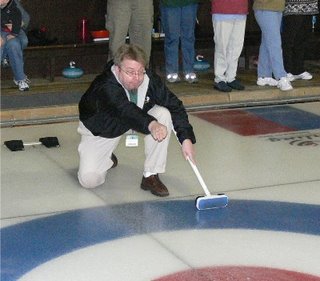
Apparently I'm not alone: The open house drew somewhere between 150 and 200 people, vastly more than the 20 to 40 they expected. The club is planning a 4-session workshop for new curlers, and I can't wait. In the meantime, here I am doing the newbie drills:

Unit of the Day: The mease (scroll down after clicking) is a unit of quantity formerly used by fishermen, equal to the number of herring in a basket (roughly 620). Try working that into a conversation!
I have a slightly different take on a lot of this. I love the Olympics, and I particularly love the Winter Games, sometimes because of the same things the critics carp about. A few thoughts about the just-completed Torino games, in no particular order:
- Obscure Sports: OK, admittedly most Americans don't care about most Winter Olympics sports other than hockey, figure skating, maybe alpine skiing, and the new darling, snowboarding. For most of us, these two weeks every four years are not only the only time we see, but the only time we even think about, sports like ski jumping, cross-country skiing, and speedskating... never mind even more obscure sports like short-track speedskating, biathlon, or curling. Do we care that short-track is the national sport of South Korea, or that biathlon is huge in northern Europe, or that curling is more popular than hockey in Canada? We do not, anymore than we care about how much the rest of the world loves soccer.
But friends, this is a feature, not a bug! If you're any sort of sports fan at all -- or any sort of TV fan -- it should delight you to have spread before you a buffet of something different, in the same way that a literal buffet of new and different foods would. Like exotic foods, some of the Winter Games sports may not be to your taste, and others may be interesting only as an occasional diversion... but their very unusualness is a gift all its own. I probably would never watch most of the Winter Games sports regularly, the way I do baseball or college basketball, but for 2 weeks every 4 years, what's not to love? I'm old enough to remember the early days of ESPN, when it was primarily a sports news network and didn't yet have broadcast rights to many (if any) major sporting events. To fill the time between SportsCenters, they televised a variety of weird and wonderful sports, from hurling and Australian rules football to competitive aerobatics. Even earlier, ABC's Wide World of Sports used to "span the globe" to bring to U.S. TV the "constant variety of sport"... including many of the same "obscure" sports (like skeleton) that now grace the Olympic Winter Games. Sure, it's not steak-and-potatoes sports... but isn't it fun to at least sample some reindeer meat every now and then?
- Medal Counts: Much was made of the U.S. team's poor medal performance, and to be sure there were many U.S. medal hopefuls who failed to reach their potentials... but the key words here are "hopeful" and "potential." In fact, while the popular press was trumpeting hopes of record medal hauls, the more analytical sports press was more realistic: Historically nations experience a significant drop in medal count (on the order of 40 percent) in the Games immediately after they host an Olympiad, and while many U.S. athletes were capable of threatening for medals, fewer were actually predicted to finish on the podium. Take Bode Miller (please!): All the buzz going into the Games was that he might medal in all 5 alpine skiing events... but Sports Illustrated's pre-Games analysis actually only predicted a medal in one event, the alpine combined. Viewed that way, his undeniable collapse seems somewhat less epic.
As it happened, the U.S. finished second in overall medals (with 25, 1 behind Germany's total) and tied for second in gold medals (with 9). It was our second-best performance ever, behind only the home-field Salt Lake City games, and actually better than most countries do right after hosting their own games. The public's perception of a disastrous performance by the U.S. team has much more to do with pre-Games expectations -- which the U.S. Olympic Committee has admitted it mismanaged -- than with objective reality.
- "Ugly American" Athletes: OK, so Bode Miller partied, Lindsay Jacobellis showboated, and Chad Hedrick and Shani Davis spent the whole fortnight glaring at each other. Get over it: Part of the package with world-class athletes is a certain degree of arrogance and self-focus... it's an inherent ingredient of what drives them to be the best. It's extraodinarily rare to find the fierce competitiveness of a world-class champion living side-by-side with selfless altruism in the same human body.
Rare, but not unheard of: For every story like the ones mentioned above, there's a Joey Cheek, who turned over his medal bonuses to charity without even thinking twice... or an Apolo Anton Ohno, who, after seeming somewhat selfish himself in Salt Lake City, apeared to have an almost spiritual appreciation of pure sport this time 'round... or a Lindsay Kildow, who grittily continued to compete despite injuries that made it impossible for her to win... or an Evan Lysacek, who shook off the disappointment of a disastrous short program in men's figure skating to give the performance of his life in the long program and nearly claim a medal... or a Shaun White, whose sheer boyish charm and joy in what he does must have won over even the most curmudgeonly despiser of snowboarding.
In short, I think we Americans have far more to be proud of than to apologize for.
Apparently I'm not alone: The open house drew somewhere between 150 and 200 people, vastly more than the 20 to 40 they expected. The club is planning a 4-session workshop for new curlers, and I can't wait. In the meantime, here I am doing the newbie drills:


Unit of the Day: The mease (scroll down after clicking) is a unit of quantity formerly used by fishermen, equal to the number of herring in a basket (roughly 620). Try working that into a conversation!
Thursday, March 16, 2006
News from Other Blogs
First, a quick assist to ATalbot, friend of the Spleen and proprietor of the Bye Bye Rob blog. Blogger's comment feature wouldn't let him post the following flyer for this weekend's anti-war rally in Hartford, but I can post in a main entry, so here it is:

ATalbot (I have to ask him if he minds whether I use his real name) also attended Ned Lamont's announcement that he will challenge Joe Lieberman in the Democratic primary for U.S. Senate from Connecticut (maybe he'll give us a report in a comment to this post). He is one of a group of teens -- friends of my daughter's -- who continue to give me hope for the future, because they are so much more involved in serious thought about real issues (politics, the arts, etc.) than I remember being at that age.
Next, I found myself compelled yesterday to comment in a thread at the blog of Steven Berlin Johnson, the author of Everything Bad Is Good for You. Taking off on the recent reports about Barry Bonds' alleged steroid use, Johnson ponders whether "performance enhancing" substances are really all that different from other performance enhancements, such as laser eye surgery that enhances already good vision. After I added my comment, it dawned on me that I shouldn't have wasted my perfectly good words (OK, that's a matter of opinion, admittedly) on somebody else's blog... so I'm shamelessly plagiarizing myself by repeating my comments here:
The conversation about "performance enhancing" substances/practices reminds me strangely of the controversy over genetically modified animals/crops: They're both based on the same false dichotomy between "artificial" and "natural."
Just as all domesticated plants and animals are really genetically modified, whether through the slow and tedious "natural" methods of selective breeding and culling or the "artificial" methods of the laboratory, so too are all elite athletes "performance enhanced" compared to non-athletes. At first glance, it might seem easy to differentiate between "natural" performance-enhancing measure (i.e., special diets, exercise regimes, training, physical therapy, sports psychology) and "artificial" ones such as drugs and surgical body modification... but on closer inspection, such distinctions can seem pretty arbitrary. During the recent Winter Olympics, several cross-country skiers were temporarily suspended because of elevated hemoglobin levels. My understanding is that these levels might result from illegal doping... but they might also result from "natural" causes, including high-altitude training.
Because the raison d'etre of sports is competition, and some basic standard of fairness is essential to competitive integrity, I think there is a basis for discriminating between performance enhancing measures... but based on equal access, rather than on the imagined moral superiority of "natural" methods: An athlete shouldn't feel compelled to become a criminal in order to have a fair chance of winning, so it's reasonable to ban illegal drugs; an athlete shouldn't feel compelled to risk his/her life for sport, so it's reasonable to ban life-threatening practices. (Note that the latter does not imply that merely unhealthy practices should be banned: By the standards of "normal life," much of what elite athletes do with regard to training and diet could be called unhealthy.)
Under my model, illegal steroids should be banned, NOT because they're "performance enhancing," but because allowing their use would put athletes unwilling to engage in criminal behavior at an unfair disadvantage, and thereby damage the basic competitive equity of the sport. Substances that are legal (e.g., anything you can buy at a GNC store) should NOT be banned, regardless of their "performance enhancing" characteristics, and substances that are illegal but not performance enhancing should not be specifically banned by sporting organizations. (That is, Ricky Williams' fondness for the ganja is between him and the cops, but to my mind no business of the NFL's, unless you can convince me that smoking dope makes him a better football player.)
As for eye surgery and other "artificial" enhancements, I say as long as they're freely available to all and don't present any extreme risks, there's no reason to restrict them.
Of course, I'm the commissioner of exactly nothing! ;^)
If you're interested in the original thread this appeared in, it's here.
Unit of the Day: The newton (yes, named after that Newton) is the metric (SI) unit of force, equal to the force required to accelerate one kilogram at one meter per second per second. This one is familiar to space cadets, because rocket engine thrust is given in multiples of newtons (everywhere but the U.S., where we still use pounds).

ATalbot (I have to ask him if he minds whether I use his real name) also attended Ned Lamont's announcement that he will challenge Joe Lieberman in the Democratic primary for U.S. Senate from Connecticut (maybe he'll give us a report in a comment to this post). He is one of a group of teens -- friends of my daughter's -- who continue to give me hope for the future, because they are so much more involved in serious thought about real issues (politics, the arts, etc.) than I remember being at that age.
Next, I found myself compelled yesterday to comment in a thread at the blog of Steven Berlin Johnson, the author of Everything Bad Is Good for You. Taking off on the recent reports about Barry Bonds' alleged steroid use, Johnson ponders whether "performance enhancing" substances are really all that different from other performance enhancements, such as laser eye surgery that enhances already good vision. After I added my comment, it dawned on me that I shouldn't have wasted my perfectly good words (OK, that's a matter of opinion, admittedly) on somebody else's blog... so I'm shamelessly plagiarizing myself by repeating my comments here:
The conversation about "performance enhancing" substances/practices reminds me strangely of the controversy over genetically modified animals/crops: They're both based on the same false dichotomy between "artificial" and "natural."
Just as all domesticated plants and animals are really genetically modified, whether through the slow and tedious "natural" methods of selective breeding and culling or the "artificial" methods of the laboratory, so too are all elite athletes "performance enhanced" compared to non-athletes. At first glance, it might seem easy to differentiate between "natural" performance-enhancing measure (i.e., special diets, exercise regimes, training, physical therapy, sports psychology) and "artificial" ones such as drugs and surgical body modification... but on closer inspection, such distinctions can seem pretty arbitrary. During the recent Winter Olympics, several cross-country skiers were temporarily suspended because of elevated hemoglobin levels. My understanding is that these levels might result from illegal doping... but they might also result from "natural" causes, including high-altitude training.
Because the raison d'etre of sports is competition, and some basic standard of fairness is essential to competitive integrity, I think there is a basis for discriminating between performance enhancing measures... but based on equal access, rather than on the imagined moral superiority of "natural" methods: An athlete shouldn't feel compelled to become a criminal in order to have a fair chance of winning, so it's reasonable to ban illegal drugs; an athlete shouldn't feel compelled to risk his/her life for sport, so it's reasonable to ban life-threatening practices. (Note that the latter does not imply that merely unhealthy practices should be banned: By the standards of "normal life," much of what elite athletes do with regard to training and diet could be called unhealthy.)
Under my model, illegal steroids should be banned, NOT because they're "performance enhancing," but because allowing their use would put athletes unwilling to engage in criminal behavior at an unfair disadvantage, and thereby damage the basic competitive equity of the sport. Substances that are legal (e.g., anything you can buy at a GNC store) should NOT be banned, regardless of their "performance enhancing" characteristics, and substances that are illegal but not performance enhancing should not be specifically banned by sporting organizations. (That is, Ricky Williams' fondness for the ganja is between him and the cops, but to my mind no business of the NFL's, unless you can convince me that smoking dope makes him a better football player.)
As for eye surgery and other "artificial" enhancements, I say as long as they're freely available to all and don't present any extreme risks, there's no reason to restrict them.
Of course, I'm the commissioner of exactly nothing! ;^)
If you're interested in the original thread this appeared in, it's here.
Unit of the Day: The newton (yes, named after that Newton) is the metric (SI) unit of force, equal to the force required to accelerate one kilogram at one meter per second per second. This one is familiar to space cadets, because rocket engine thrust is given in multiples of newtons (everywhere but the U.S., where we still use pounds).
Tuesday, March 14, 2006
A Manor of Thy Friend's or of Thine Own
"No man is an island, entire of itself; every man is a piece of the continent, a part of the main. If a clod be washed away by the sea, Europe is the less, as well as if a promontory were, as well as if a manor of thy friend's or of thine own were: any man's death diminishes me, because I am involved in mankind, and therefore never send to know for whom the bell tolls; it tolls for thee."
Not merely the source for well known titles of war movies and novels, this excerpt from John Donne's Meditation XVII is a penetrating insight into the human condition.
That is, it's a penetrating insight into how some of us view the human condition. In ruminating on my noontime political chautauquas with my CCLB and my Fellow Liberal Lunch Buddy (FLLB) [they know who they are, and they'll likely be recurring characters here at the Spleen], I've been trying sort something out: How is it that decent, well-meaning people with similar backgrounds, education, and current lifestyles can hold such diametrically opposed opinions. I like to think I'm a rational person, but I don't flatter myself that I'm noticeably smarter than my CCLB (for instance), so how does his exercise of reason lead him to conclusions that seem so unreasonable to me?
I've decided that the only explanation is that he and I -- and conservatives and liberals generally -- start reasoning from fundamentally different beginning assumptions. Before you say "Duh! That's pretty obvious!", bear with me: I don't think it really is all that obvious to most people, and I think much of the acrimony in our current political discourse springs from the failure to understand this basic principle.
Here's what I think I now understand: Conservatives are fundamentally anti-social. Now wait... I don't mean that word in its typical pejorative sense; rather, I mean that at some level they don't believe in society, at least not in the same way liberals do. An old antagonist of mine on a space bulletin board used to argue whenever I would use the word "we" in talking about the space program (e.g., "we went to the Moon"; "we've sent spacecraft to every planet but Pluto"; etc.), on the grounds that I hadn't personally participated in those activities. For a long time, I thought he was being deliberately obtuse, for no other reason than to pick fights. Actually, I still think he was doing that, but I eventually figured out there was more to it: I was saying "we" meaning humankind, or in some cases the United States, with the understanding that as a human and an American, I did participate in those activities. He was having none of it: To him, there was no such thing as society, and if you hadn't done something in your own person, you hadn't done it at all. He did not believe that "every man is a piece of the continent, a part of the main," and he certainly didn't believe that "any man's death diminishes me, because I am involved in mankind."
To him... and I suspect to conservatives in general... society, as an integrated whole, does not exist, and what goes under that name is really just a collection of individuals, each ultimately responsible to (and for) him/herself alone. This is, I've come to believe, at the root of many political arguments about such issues as tax policy, public education, and government programs in general. It also may explain why conservatives consider socialism such a dirty word!
With this philosophical chasm in mind, it's easier to understand why the health care/health insurance issue has been so intractable in U.S. politics. To understand why it's so important, and get a good (if somewhat disheartening) overview of what we should -- but probably can't -- do about it, check out this article from the New York Review of Books (thanks to the Altercation blog for highlighting this). It's a long read, but well worth it if you're at all interested in public health care policy.
Unit of the Day: The sabin has nothing to do with the discoverer of the oral polio vaccine; it's a measure of sound absorption used by acoustical engineers, equal to the absorption of one square foot of a perfectly absorbing surface. Now a perfectly sound-absorbing surface sounds like a pretty useful thing, doesn't it?
Wednesday, March 08, 2006
A Peppering of Birdshot
Once again I've let too much time go by between posts, what with one thing and another. I've got a few longer posts in the works, but in the meantime here's a 28-gauge blast of random thoughts:
Sweet Home, South Dakota... As a follow-up to my thoughts on South Dakota's abortion ban, which Governor Mike Rounds has now signed into law (to less than rave reviews at home and abroad), I note the following from a CBS News web report: "Lawmakers said an anonymous donor has pledged $1 million to defend the ban, and the Legislature set up a special account to accept donations for legal fees." I suppose I just never thought about it, but I didn't realize states could accept private donations to defend laws against legal challenges. Now that I have thought about it, I think it's a bad idea: I can't come up with a legal theory for banning the process, but in principle I'm concerned that it has the effect of isolating legislators from responsibility for the laws they pass. If the state's taxpayers were footing the bill for all those millions of dollars in legal costs, their representatives might think twice before passing a patently unconstitutional law whose real purpose is to advance a national political agenda. As it is, the South Dakota legislature is now a regiment of mercenaries, fighting someone else's battle in the pay of outside money. If it were my state's legislature, I'd be pissed... regardless of how I felt about the issue at hand.
Blogstyles of the New and Clueless... I finally got caught up reading my daughter's blog (with her permission; I'm not snooping), and I see she initially took offense at my previous comments about high-schoolers' blogs. She quickly figured out I didn't mean to insult her and her friends -- she's a very smart kid -- but I wanted to say publicly that my comment about kids being interested in the minutiae of each other's lives was in no way intended as a putdown. It's one of the special magics of that age that your life should be so intimately connected with those of your friends; revel in it while you can. In any case, I'm new (and clueless!) at this whole deal, while she has just celebrated the second anniversary of her blog. If there were any conflict between our blogging styles, you'd have to give her way precedence!
These Dadgum Newfangled Computers... Along the same lines, at work today my Cranky Conservative Lunch Buddy (CCLB) was holding forth about how modern communication technologies like voicemail and e-mail have caused people to stop talking to one another. Me, I don't buy it. No doubt new technologies can present challenges to social behavior, but since we're stuck with them it's useless to wring our hands about how awful they are. In any case, I think computer-based communication enhances rather than degrades sociability. My CCLB was talking about how careful he and his wife are to police their kids' computer usage, so they will go out and play with other kids face-to-face instead. My perception, though, is that my daughter and her friends use blogging, e-mail, IM, and the web to add to, not replace, their face-to-face interaction. They spend plenty of time together in "meat-space"; the computer just helps them arrange it. And IM makes for great virtual study groups, too. I say bring on the pixels!
Do (Hungry) Gentlemen Prefer Blondes?... If they make a sequel to Splash, do you suppose Daryl Hannah will play this part?
Unit of the Day: The mickey, used by computer programmers, is the length of the smallest detectable movement of a computer mouse (mouse... mickey... get it?) or similar input device. Its absolute size depends on the specific equipment, but roughly 0.1 millimeter would be a typical value.
Subscribe to:
Posts (Atom)